
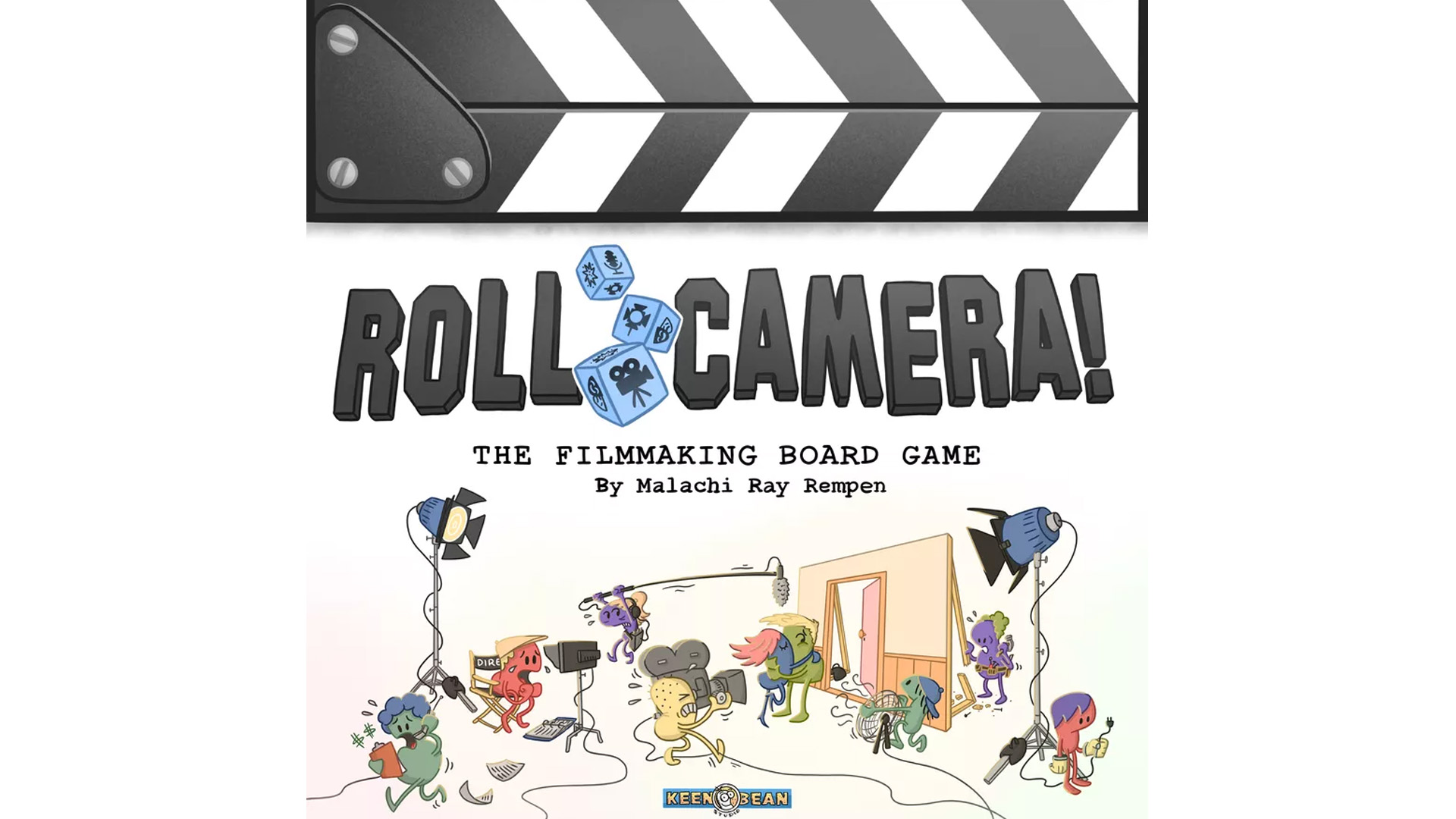
Lights! ROLL CAMERA! Action!
Roll Camera is a terrific cooperative game of movie making. Aaaaaaand I’m sold. No, really, that’s right up my alley.
I have mentioned my background on and off over the years. It is far-reaching and varied, almost unbelievably so. Some of that background involves working in the film industry. While it was never my passion, I still have a number of friends and family in the industry and I have often been brought into film-adjacent projects because of that background. That same experience leaves a soft spot in my otherwise cold, hard heart for movie based games.
Not only is Roll Camera a fun game on its own, but it is surprisingly faithful to the theme. Sometimes in ways you might not even expect. I’ll come back to this more in a bit, but the main mechanic is pattern-matching dice placement. It took several games before I realized that the dice patterns made sense in relation to the artwork for the scene that it is used for.
The goal of the game is to complete five scenes of a movie (in a column on the right side of the board) before running over schedule or out of budget. There are three possible scenes players can complete in the storyboard (at the left of the board), with new scenes being revealed as existing scenes are created or discarded. To complete scenes, players must work together to build a set out of tiles and then place the required dice in the pattern shown on that scene card. To take an action, such as building a set piece, you assign one, two, or sometimes even three dice to that action.
The game starts by selecting a character. Each character represents a job on a reel-life (pun intended) movie set. Each Character gives that player access to unique abilities that may help during the game. Then you come up with the title of your future masterpiece by revealing two script cards that give you a title and affect the final scoring. Next, you set up three Storyboard cards. These are the tableaus that you are collectively trying to create with the dice, and that will eventually make up the scenes of your film.
Every turn, before anything else, problems occur. These problems also require you to assign dice to them to resolve. Doing this obviously reduces the number of dice available to do other things, but if you don’t address problems they get harder to fix and new problems keep happening.
Of course, to assign dice, you need to roll the dice. The Crew Dice have (extremely clear) icons representing Lights, Camera, Sound, Actors, Art Department, and Wild. Most actions require one die of any face. Some take a matching pair or even three of a kind. Other spaces can only be occupied by specific crew types. For example, you can spend a pair of dice to draw and place a set piece token on the set grid. That set piece might let you place any die, or a specific die, in a given space. This is ultimately how you complete the scenes required to win the game. You build a set and place crew dice in the configuration shown on the scene you are trying to shoot.
At the end of a player’s turn, any dice on the set are locked in, but the rest of the dice are cleared from the board, another problem is drawn, and the next player rolls the remaining unlocked dice. There are more actions available during players’ turns, but building the set and placing the crew dice are the important ones. (Actually, it could be argued that resolving the problems is the most important thing, but I’ll leave that to you to decide when you play.)

As all of this is happening, there is a budget and a schedule counter, with certain actions or inaction costing money and/or time. If you run out of either, you lose. If you complete five scenes that are good enough or bad enough, you win. If you finish five scenes, but they are only mediocre, you lose.
Honestly, I’m not doing Roll Camera justice with that overview. The game is FABULOUS. It’s one of the few games that play well at any player count. Although more players obviously provide access to more player abilities and is generally more fun. If I’m given the opportunity to play it, I’ll almost certainly say “yes, please!” Despite this review, I don’t actually own a copy of Roll Camera. I was lucky enough to borrow a copy of the game from my friends Scott and Anita of The Read-Along podcast. I streamed a solo game of it, some time ago, and last Christmas I put out a solo game of their X-Mas Movie Story Pack expansion. So if you want to watch those, they are available on our YouTube Channel. Then you can decide for yourself.
You can find Keen Bean Studios online at keenbean.studio or on Facebook at facebook.com/keenbeanstudio.
You can find Grand Gamers Guild online at grandgamersguild.com or on Facebook at facebook.com/grandgamersguild.